

Fuel: pumps, filter and injectors
From tank to cylinder, fuel makes a journey that on a modern diesel ends at more than 2,000 bar. Here are the parts along the way, which ones fail and why putting petrol in a diesel is one of the worst things you can do to a car.
Low and high pressure
Inside the tank, under the rear seats, there is an electric low pressure pump. On a port injection petrol engine, that pump is enough: it sends the fuel at about 3 or 4 bar to the injectors, which spray it into the intake. Illustration 1 shows the tank, the pump and the line to the engine in green.

Direct injection petrol engines also have a high pressure pump, driven by the camshaft, which raises the fuel to between 100 and 350 bar to inject it straight into the cylinder. And common rail diesels have another high pressure pump, much stronger: the diesel reaches the rail at between 1,600 and more than 2,000 bar, and from there each injector.
The filter
On diesels the filter is a key part: as well as dirt, it separates water, which can wreck the high pressure pump and the injectors, and many have a heater so the diesel does not thicken in winter. It is replaced according to the manufacturer’s schedule, and on some cars the water has to be drained now and then. On many petrol cars the filter sits inside the tank, next to the pump.
The injectors
They decide how much fuel goes in and when, in thousandths of a second. On a diesel they inject several times for each firing, so it burns more smoothly and cleanly. An injector that drips, sticks or sprays badly gives jerks, smoke, extra consumption and, on a diesel, more soot for the particulate filter.
If you put in the wrong fuel
Petrol in a diesel: do not start the car, and on many models do not even switch the ignition on, because the tank pump already starts sending it. Petrol strips the lubrication that diesel gives the high pressure pump, and as that pump wears it sheds metal particles that end up in the injectors. A recovery truck, draining the tank and flushing the system is far cheaper than a pump and four injectors. Diesel in a petrol car is less serious, but do not start it either.
The most common faults
- Tank pump
Long cranking, a car that cuts out or loses power uphill, a different whine when you switch on.
Typical codes: P0230, P0627 - Low rail pressure
High pressure pump, clogged filter, regulator or a leak. The car has no power or goes into limp mode.
Typical codes: P0087, P0089, P0093 - High rail pressure or sensor
The regulator does not release or the sensor reads wrong.
Typical codes: P0088, P0190, P0191 - Injector
Jerks, misfires on one cylinder, smoke. On diesels, also knocking and excessive leak-off.
Typical codes: P0201, P0202, P0203, P0204, P0263 - Fuel level sender
The fuel gauge says what it likes, or sticks.
Typical codes: P0460, P0461, P0462, P0463
What you can see with Final OBD
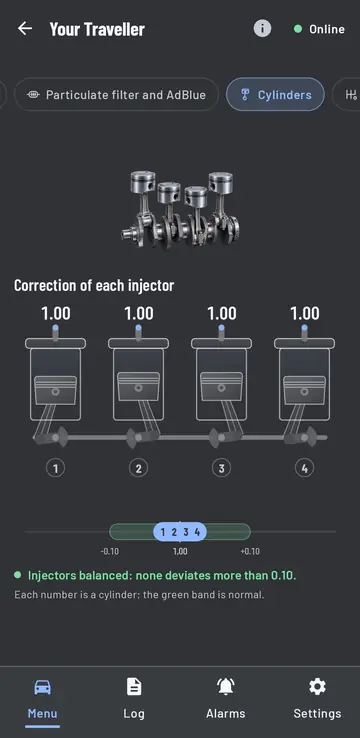
On cars that provide it over standard OBD, Final OBD shows the fuel rail pressure live, and the pressure the control unit is asking for: if the actual one does not reach the requested one when you accelerate, there is your problem. And on many diesels you see the correction of each injector, cylinder by cylinder, which is the best clue to which one is starting to fail.
Open the bonnetthe in-depth explanation
Why so much pressure
The higher the pressure, the finer the fuel is atomised into tiny droplets, and smaller droplets burn better, more completely and more cleanly. On a diesel, which has to light by itself in an instant, it is essential: at 2,000 bar, diesel leaves the injector at hundreds of metres per second. That is why the pumps and injectors of a modern diesel are watchmaker-grade precision parts, with clearances of a few microns, and why any dirt or lack of lubrication kills them.
The control unit regulates the pressure
The control unit decides what pressure it wants in the rail according to load and revs, measures it with a sensor and adjusts it with a valve on the pump or the rail. The same goes for direct injection petrol engines. When the actual pressure does not follow the requested one, it logs low or high pressure. That comparison, on cars that provide it, is the best test of the high pressure pump.
Several injections per cycle
A modern diesel does not inject just once: it makes one or two tiny pilot injections so combustion starts gently (that is why they no longer make that old rattling noise), the main one and, sometimes, one or two late ones for the particulate filter. Piezo injectors are so fast they can do all of that within a single turn.
Leak-off and testing the injectors
Many diesel injectors return a little diesel to the tank through a leak-off pipe. A worn injector returns more than it should. A garage measures it with a leak-off test, fitting a small pipe and bottle to each one and comparing, or by reading each injector’s correction with a diagnostic tool: if one corrects much more than the rest, it is the suspect.
Winter and diesel
In severe cold, the paraffins in diesel crystallise and thicken it until they block the filter. That is why winter diesel is sold with cold-weather additives, and why many filters have a heater. If you head somewhere very cold with summer diesel in the tank, you can end up stranded.
Petrol in a diesel, in depth
A common rail high pressure pump is lubricated by the diesel itself. Petrol is a solvent: it washes that lubrication away, parts rub dry, shed metal particles and those particles travel along the rail to the injectors. If the car is started and driven, the repair can mean pump, rail, pipes and injectors. If it is not started, draining and flushing is enough. It is one of those cases where doing nothing is the best thing you can do.
All sections of the mechanics guide
See it in your own car
Almost everything in this guide can be seen with Final OBD and an adapter plugged in: faults explained, live data and the details of each system.