

Engine oil: pump, sump, pressure and filter
Oil is the engine’s lifeblood, and behind almost every expensive failure there is an oil that was not the right one or was changed too late. Here is where it goes, what it lubricates, what pressure it should have and how to choose it.
Where the oil goes
The oil sits at the bottom, in the sump. The pump, driven by the crankshaft, sucks it up through a strainer, pushes it through the filter and sends it under pressure along passages drilled in the block: to the crankshaft bearings, the con rods, the camshafts and valves in the head, the turbo, the variable valve timing, the chain tensioner and, on many engines, to jets that cool the pistons from underneath. Then it falls back into the sump. Illustration 1 shows the whole route in amber.

Wet sump and dry sump
Almost every car has a wet sump: the oil lives at the bottom of the engine. Racing cars and some sports cars have a dry sump: the oil is kept in a separate tank and several pumps collect it from the engine. That way it does not run short of oil in very fast corners, when everything surges to one side, and the engine can sit lower.
Pressure and the warning light
The red oil light does not say the oil is low: it says there is no pressure. If it comes on while driving, stop as soon as you can and switch the engine off: a few minutes without pressure are enough to seize an engine. With the engine hot and idling, low pressure is normal, around 1 bar, rising to 3 to 5 bar with revs, depending on the engine.
Why good oil, changed on time, matters
Oil does not just lubricate: it cools, cleans and protects. Over the miles it gets dirty with soot, diluted with fuel on short trips, and its additives wear out. Changing it late, or using one the manufacturer does not specify, is what stretches chains, kills turbos, breaks up belts that run in oil and fills the particulate filter with ash. The number on the can, for example 5W-30, is the viscosity: the 5W when cold (the lower, the better it starts in winter), and the 30 when hot. But what really counts is the manufacturer’s standard in the handbook.
The most common faults
- Low oil pressure
Low oil, a worn pump, a blocked strainer or bearings with play. Stop the engine.
Typical code: P0524 - Oil pressure sensor or switch
The light flickers or comes on for no reason, or the control unit gets a reading that makes no sense.
Typical codes: P0520, P0521 - Engine burning oil
Piston rings, valve stem seals or the turbo. Many manufacturers consider up to half a litre every thousand kilometres normal; more than that needs looking at.
- Oil level rising
It is filling up with fuel: interrupted regenerations on a diesel or a rich mixture on a petrol engine.
- Leaks
Sump gasket, seals or a filter not tightened properly. A leak onto the timing belt is serious.
What you can see with Final OBD
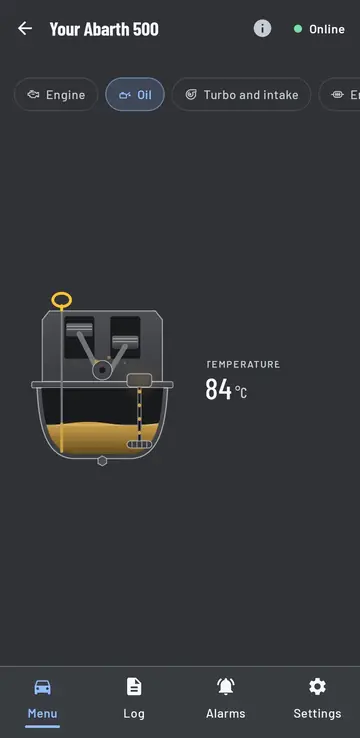
On cars that provide it, Final OBD draws the inside of the engine with its oil and its temperature live, and on some the pressure. Oil temperature is what really tells you when you can push the engine: it takes a good while longer than the coolant to get there.
Open the bonnetthe in-depth explanation
How it really lubricates
A crankshaft bearing does not turn metal on metal: it turns on a film of oil a few thousandths of a millimetre thick, which the rotation itself keeps under pressure, like a water ski. As long as that film exists, wear is almost nil. It breaks down when the oil is too thin (from heat or from being diluted with fuel), when it does not arrive under pressure or when it carries dirt. That is why cold starts are when most wear happens: for a few seconds, the oil has not yet reached everywhere.
Viscosity, without the confusion
0W-20, 5W-30 or 5W-40 are viscosity grades: the first number says how it flows when cold and the second how thick it stays at 100 degrees. Modern engines, with tight clearances, call for thinner oils to save fuel and lubricate sooner when cold. Using a thicker one "just in case" does not protect more: when cold it arrives later, and some systems, like variable valve timing or the chain tensioner, are calibrated for a specific oil.
The standards, which are what matter
As well as the viscosity, every oil meets certain standards: the European ACEA ones (the C ones are low ash, the ones cars with particulate filters ask for) and each manufacturer’s own, which appear in the handbook with their own code. Two 5W-30 oils can be very different: one low ash, designed for a diesel with a filter, and one that is not. The right one is the one that meets your car’s standard.
Additives and ash
An oil is a base with lots of additives: detergents that keep soot in suspension so it leaves with the oil change, anti-wear additives that protect parts rubbing under high pressure, antioxidants, anti-foam agents. Some contain metals, and the little the engine burns of them ends up as ash in the particulate filter. That is why diesels with a filter call for low ash oils, and why an engine that burns oil fills its filter sooner.
The pump and the pressure
The pump delivers more flow with more revs, and a relief valve limits the maximum pressure. Many modern engines have variable displacement pumps, which give only the pressure needed at each moment so as not to steal power from the engine. Pressure drops with the engine hot and idling, because the oil is thinner, and that is normal; what is not normal is the light coming on or the pressure not rising when you accelerate.
When to change it
There are fixed plans, of one year or about 15,000 kilometres (around 10,000 miles), and long-life plans, up to 30,000 kilometres or two years, with special oils and an indicator that decides based on use. Long-life plans are meant for cars that do open-road miles. If your car mostly does short trips, town driving, towing or lots of heat, shorten it: it is the cheapest way to make everything expensive in the engine last longer. And check the level now and then, with the engine warm, on level ground and after waiting a few minutes for it to drain down.
All sections of the mechanics guide
See it in your own car
Almost everything in this guide can be seen with Final OBD and an adapter plugged in: faults explained, live data and the details of each system.