

Cylinders, one by onePro
Your engine, cylinder by cylinder
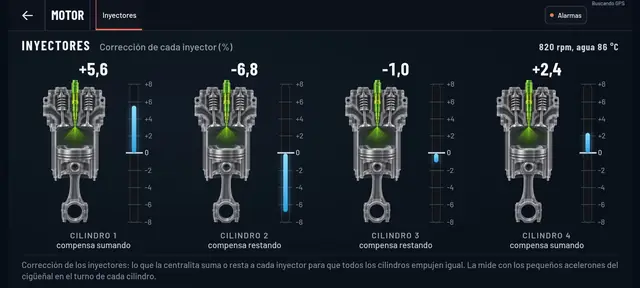
When an engine shakes at idle, drinks more than it should or feels down on power, there’s nearly always one cylinder doing its own thing. The control unit knows, and it corrects for it. Final OBD shows you those corrections, cylinder by cylinder, so you can see which one it is.
- InjectorsWhat the control unit adds to or takes away from each injector.
- KnockHow many degrees the spark is pulled back on each cylinder.
- MisfiresHow many times each cylinder hasn’t pulled its weight.
- As an X-rayEvery cylinder drawn with its own bar and number.
Injector correction
What injector correction is
For an engine to run smoothly, every cylinder has to push the same. But no two injectors are exactly alike, and as the miles go by each one wears in its own way.
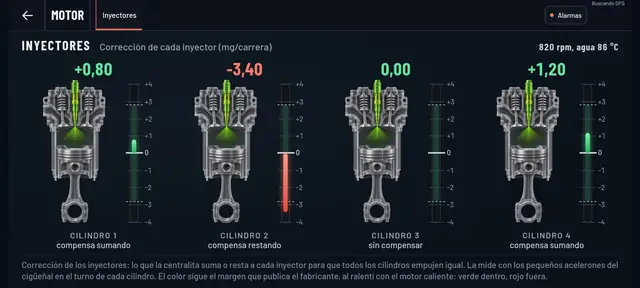
The control unit picks this up at the crankshaft: when a cylinder pushes less, the crank loses a little speed right on its turn. So it gives that injector a bit more fuel, or a bit less to the one pushing too hard. That’s the correction, and on a diesel it’s usually shown in milligrams per stroke.
- Close to zero: that injector is fine.
- Correcting upwards: the control unit gives it more fuel because it’s pushing less.
- Correcting downwards: it takes fuel away because it’s pushing too much.
What matters is the comparison. If three cylinders sit close to zero and one is correcting a lot more, that injector is your suspect. When we know the figure the manufacturer gives as normal, you’ll see it drawn alongside.
Knock
What knock is
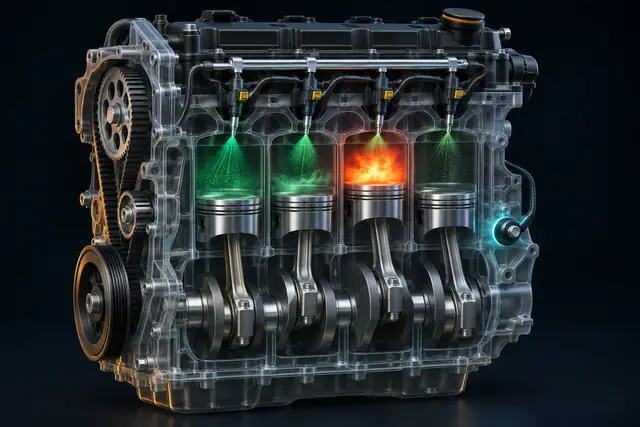
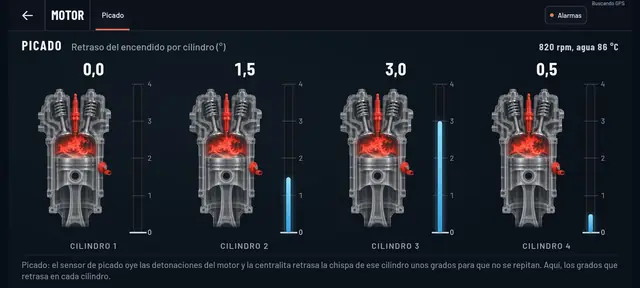
In a petrol engine, the air-fuel mixture has to burn when the spark fires. If it goes off early, because of heat, poor fuel or carbon build-up, you hear a metallic tapping: that’s knock.
The engine has a sensor that listens for those detonations. When it picks them up, the control unit retards the ignition timing on that cylinder by a few degrees so it doesn’t happen again. That protects the engine, but you lose a bit of power.
- Zero or nearly zero: no knock.
- A few degrees now and then: normal in hot weather or at full load.
- One cylinder always pulling timing: worth a look, especially if the car feels like it’s pulling less.
Misfires
What a misfire is
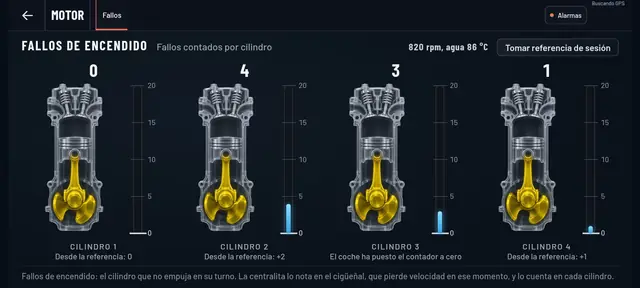
A misfire is a cylinder that doesn’t burn on its turn. You feel it as a jerk or a shudder, and if it keeps happening the engine warning light comes on.
The control unit counts them cylinder by cylinder. Final OBD shows you that counter and lets you take a reference for the session: you set your count to zero, drive for a while and see which cylinder adds up.
The most common causes are a worn spark plug or coil, an injector that drips or sticks, or an air leak. Knowing which cylinder it is saves you swapping parts blind.
Upright too
In the Cockpit and in Your car
With your mobile on its side, each reading has its own Cockpit screen with the cylinders shown big. With your mobile upright, the Cylinders tab in Your car puts all three together.
And if your engine has six, eight or twelve cylinders, they all show up. Whatever your car doesn’t give, doesn’t appear.
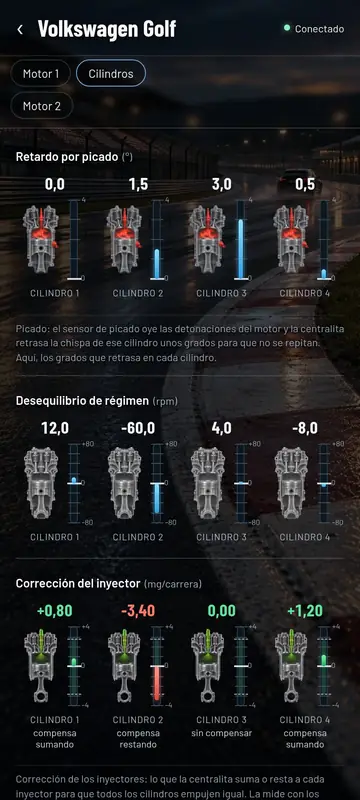
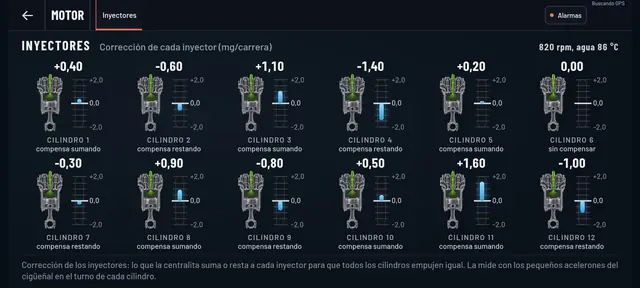
What you see is what your car’s control unit measures and corrects. It helps you know where to look, but it doesn’t replace a check at a garage. Which readings you get depends on each engine.
See inside your car this very afternoon
A cheap OBD adapter, the app on your mobile and five minutes. And if you don’t have an adapter yet, the app comes with a demo of a real car so you can see it all first.
Out now in the stores