

The accelerator: cable or electronic
Years ago, the pedal pulled a cable that opened the throttle. Today it is almost always a request: the pedal tells the control unit how much you want to accelerate and the control unit decides how far to open. Here is how it works and why a car sometimes loses power all of a sudden.
Cable
On older cars, the accelerator pedal pulls a steel cable that runs to the engine’s throttle on a petrol car, or to the injection pump lever on a diesel. What you press is what opens, no more and no less. Simple and direct, but with no help from electronics. Illustration 1 shows the pedal and its route to the engine in yellow.

Electronic
On modern cars there is no cable: the pedal has two sensors that measure how far you press it, and the engine control unit opens a motorised throttle, which also has two sensors so it knows where it is. This is called drive by wire. The control unit does not open what you press: it opens what it thinks is needed to give you the power you ask for, and that is what makes cruise control, traction and stability control, or driving modes work, changing how the pedal responds without touching the engine.
Why there are two sensors of each
Because a throttle that sticks open is dangerous. The two pedal sensors measure the same thing in two different ways, and the control unit checks all the time that they agree. If they do not, it does not trust them: it goes into limp mode, limits revs and power, and lets you get home or to a garage slowly. The same with the throttle sensors. And if you press brake and accelerator together, most cars give priority to the brake.
The most common faults
- The pedal sensors disagree
The car suddenly loses power and will not rev past a certain point. Usually the pedal, its connector or the wiring.
Typical codes: P2135, P2138, P2122, P2127 - Dirty or faulty motorised throttle
Unstable idle, jerks or a car that stalls. Often it is carbon, and after cleaning the control unit has to relearn it.
Typical codes: P0638, P2101, P2119, P0507 - Limp mode because of the throttle
The control unit restricts the throttle for safety.
Typical codes: P2110, P2112, P2111 - Sensor reference voltage
A single electrical fault leaves several sensors without a signal at once, the pedal one among them.
Typical codes: P0642, P0643, P0651
What you can see with Final OBD
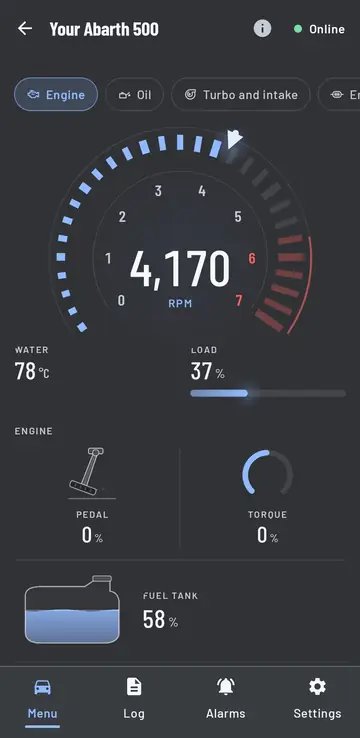
Final OBD shows you live the pedal position and the throttle position, which come with standard OBD, along with revs and load, with the engine drawing. If you floor it and the pedal does not reach one hundred per cent, or the throttle does not follow it, you know where to look.
Open the bonnetthe in-depth explanation
The pedal sensors
They can be potentiometers, like the volume control on an old radio, or contactless magnetic sensors, which do not wear. So that the control unit can detect a fault, the two give different signals: for example, one twice the voltage of the other, or one rising while the other falls. That way a short circuit or bare wire cannot fool it by making both say the same thing by mistake.
The motorised throttle
It is a disc valve at the entrance to the intake manifold, moved by a small electric motor with a reduction gear and springs that take it to a safe position, slightly open, if the power is cut. That way, if it fails, the engine can keep running at a high idle and get you home. The control unit moves it constantly for idle, for the EGR and to meter the power.
Over the years it gets coated with carbon from the crankcase breather and the EGR, and the idle becomes unstable. Cleaning it changes the position the control unit knew as closed, which is why, after cleaning, it has to relearn: sometimes switching the ignition on for a few seconds without touching anything is enough; on other cars a diagnostic tool is needed.
And diesels
On a diesel, power is not controlled with air but with the amount of fuel injected, so the pedal tells the control unit how much to inject. Even so, most have a throttle, used to make the EGR work, for particulate filter regenerations and to shut off the air when the engine is switched off so it stops smoothly.
The pedal map
Because there is a control unit between pedal and throttle, the manufacturer decides how it responds: in sport mode, a little pedal opens a lot; in eco mode, the opposite. That is why a car can feel more or less eager without the engine changing at all. And that is why there are gadgets you plug into the pedal to make it more sensitive: they do not give more power, they just get to the same power sooner.
All sections of the mechanics guide
See it in your own car
Almost everything in this guide can be seen with Final OBD and an adapter plugged in: faults explained, live data and the details of each system.