

Brakes: the pedal, the discs, the ABS and the handbrake
Brakes look simple and hide one of the loveliest tricks in a car: with one foot you squeeze four calipers with enormous force. Here is how, why the last centimetre of pedal travel brakes the most, what the ABS does and what happens to a handbrake when it slackens.
How the force from your foot reaches the wheels
When you press the pedal you push a piston inside the master cylinder, helped by the brake servo, which multiplies your force using vacuum or an electric pump. That piston pushes brake fluid through the pipes to the calipers at all four wheels, where other pistons press the pads against the discs. Illustration 1 shows the whole circuit in red.

Fluid does not compress, and that has a consequence few people know. The first part of the pedal travel only brings the pads up to the discs. From there on the pedal hardly moves, but every extra kilo you put in with your foot turns into pressure. Normal braking in town uses 20 to 30 bar in the circuit; hard braking goes past 80; an emergency stop, pressing hard and squeezing once the pedal will not go further, can reach 150 bar or more. The pedal has barely moved a few millimetres more, but the force at the wheels has gone up fivefold. In an emergency, press without fear: that is what the ABS is for.
Discs, pads and fluid
Pads wear and have a minimum; so do discs, which have their minimum thickness stamped on them. When the pedal pulses when braking from speed, the discs have deposits or uneven wear. And brake fluid absorbs moisture from the air over the years, which lowers its boiling point: on a long descent it can boil and the pedal goes to the floor. That is why it is changed roughly every two years, even if it looks clean.
The ABS
A sensor at each wheel measures its speed. If one starts to lock, the ABS releases pressure on that wheel in milliseconds, gives it back, and so on several times a second. That is why the pedal pulses and makes noise in a hard stop: it is normal, keep your foot down. A wheel that does not lock can still steer the car.
The handbrake

A lever handbrake pulls two cables to the rear brakes, the ones in illustration 2. With use, the cables stretch and the mechanisms in the calipers lose their adjustment, so you have to pull the lever higher each time for it to hold. It is fixed by tightening the cable at its adjusting nut (under the console or under the car) until it holds at about four to seven clicks, and checking the wheels turn freely when it is released. If it still will not hold, the problem is in the rear calipers or shoes. An electric one has a small motor on each rear caliper and does not slacken, but to change the rear pads those motors have to be wound back with a diagnostic tool or the button sequence the manufacturer gives.
The most common faults
- Wheel speed sensor
The ABS light comes on, sometimes the stability control light too. Usually the sensor, its wiring or a dirty or rusty reluctor ring.
- The ABS module is not answering
The other control units stop hearing it: ABS and stability lights, and sometimes the speedometer.
Typical codes: U0121, U0415 - Brake pedal switch
The brake lights do not come on, cruise control fails or an automatic will not come out of park.
Typical codes: P0571, P0504 - Discs that judder
The steering wheel or pedal shakes when braking from speed. Discs with deposits or uneven wear.
- Handbrake that will not hold
Stretched cables or seized mechanisms in the rear calipers.
- Pedal that goes to the floor
Air in the circuit, old fluid boiling or a master cylinder leaking internally. Do not drive like this.
What you can see with Final OBD
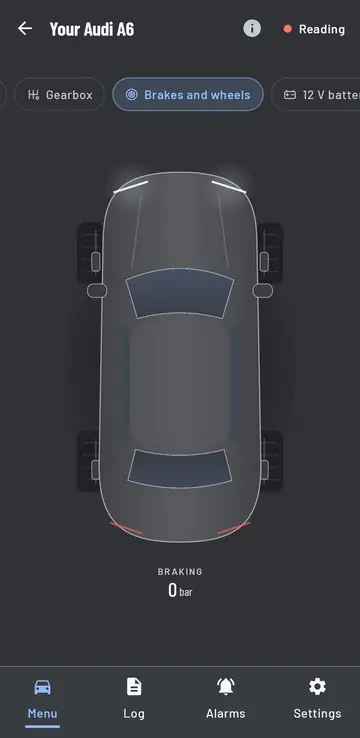
On cars that provide it, Final OBD shows the brakes and wheels from above, with live brake pressure: press gently and then hard, with the car stationary, and you will see for yourself how the pressure climbs while the pedal barely moves. And you read the faults from the ABS control unit, not just the engine, explained.
Open the bonnetthe in-depth explanation
The pedal maths
The pedal is a lever: what you push with your foot reaches the master cylinder multiplied three or four times. The servo multiplies it again, four to eight times depending on the car. And that force, on a piston about two centimetres across, becomes pressure in the fluid. In round numbers: 30 kilos of foot give around 150 bar in the circuit. That pressure, on the caliper pistons, which are much bigger, squeezes each pad with several tonnes.
The figures in this chapter are approximate: they change from car to car with the size of the master cylinder, the servo and the calipers. What does not change is the idea: pedal travel does not measure how hard you brake, force does.
Two circuits for safety
The master cylinder has two chambers and the circuit is split in two, usually diagonally: one front wheel with the opposite rear one. If a pipe bursts, the other half still brakes. The pedal will go lower and you will brake less, but you will brake.
Inside the ABS and stability control
The ABS unit is a block with a pump, an electric motor and two valves per wheel: one to hold pressure and one to release it. The control unit compares each wheel’s speed with the car’s, and when one slows more than it should, it closes its inlet valve, opens the outlet, returns the fluid with the pump and starts again. Stability control uses the same unit the other way round: it brakes one particular wheel, without you pressing, to correct a slide.
The wheel sensors read a toothed or magnetic ring. With dirt, rust or a worn wheel bearing the signal gets noisy and the light comes on. It is one of the most common faults and it is almost never the control unit.
Discs and pads: when to replace
Pads have a lining of about 10 to 12 millimetres when new; below 2 or 3, it is time to replace them, and many cars have a warning light. Discs are measured with a caliper: if they are below the minimum thickness stamped on their edge, or have a big lip, they are replaced, and always in pairs on the same axle. New pads on worn discs brake worse and glaze.
The cable handbrake, in short
The lever pulls a cable that is split to the two rear wheels, with a part that evens out the tension on both sides. If it needs a lot of clicks to hold, first check that the rear wheels turn freely with the lever down and that the cables are not rusty or seized. Then tighten it at the adjusting nut until it holds at about half travel, and check again that, with the lever down, the wheels do not drag. If it still will not hold with the cable tight, the mechanism in the calipers or the shoes in the rear drums need attention.
The electric parking brake
It has a motor with a reduction gear on each rear caliper, which pushes the piston via a spindle. The control unit knows how hard it has clamped from the motor current, so it does not slacken: it compensates by itself. The only catch is that you cannot push the piston back by hand to fit new pads, because it breaks the mechanism: it has to be put into maintenance mode first, with a diagnostic tool or the button sequence the manufacturer gives in the handbook.
A hybrid brakes differently
On a hybrid or an electric car, a good part of the braking is done by the electric motor, which recovers energy. The car shares each stop between the motor and the calipers without you noticing. That is why its pads last for ages, and why its discs, which do little work, rust more: now and then a firm stop to clean them is a good idea.
All sections of the mechanics guide
See it in your own car
Almost everything in this guide can be seen with Final OBD and an adapter plugged in: faults explained, live data and the details of each system.