

The clutch and the dual-mass flywheel
If the revs climb without the car pulling, it judders when pulling away or there is a knock when you switch the engine off, you are most likely in the right place. Here is how the clutch works, what a dual-mass flywheel is and what you can do to make them last.
What the clutch does
The clutch connects the engine to the gearbox, and separates them when you press the pedal. It is a disc with a lining similar to brake pads, squeezed between the flywheel, which turns with the crankshaft, and a plate with a very strong spring, the pressure plate. With the pedal up, the spring clamps the disc and everything turns together; press it, the spring lets go and the engine spins freely. Illustration 1 shows it in violet, between the engine and the gearbox.

The pedal works all this through a hydraulic circuit (a master cylinder at the pedal and a slave cylinder at the gearbox) or, on older cars, through a cable.
Why it fails
The disc lining wears with every pull-away and every gear change, like brake pads. When little is left, it slips: you climb a hill in a high gear, the revs rise and the car does not speed up to match. Other times it is the release bearing, which pushes the spring and squeals when you press the pedal, or the hydraulics, which leak and leave the pedal soft or stuck down.
What really kills it is how it is used: resting your foot on the pedal, holding the car on a hill with the clutch instead of the brake, pulling away in second, launching at high revs or towing heavy loads. Treated well, a clutch lasts 150,000 to 200,000 kilometres (around 90,000 to 125,000 miles); treated badly, half that.
Dual-mass or solid flywheel
An engine does not push smoothly: it gives a kick with every firing. On diesels and high-torque engines, especially at low revs, those kicks make the gearbox and the body vibrate. A dual-mass flywheel is two discs joined by springs that swallow those vibrations before they reach the gearbox. The car is smoother and the box suffers less.
But it wears too. When it develops play, you notice a knock at idle, a shudder when starting and stopping the engine, or a metallic noise when you let the clutch out. There are kits that replace it with a solid, single-mass flywheel: cheaper and almost everlasting, but they pass back to the gearbox and the body the vibrations the dual-mass one used to absorb. On an engine designed for a dual-mass flywheel it is not always worth it.
The most common faults
- Slipping clutch
The revs rise and the car does not speed up to match, especially in a high gear uphill. Worn or oily disc. It does not usually leave a code.
- Dual-mass flywheel with play
Knocking at idle, shuddering when the engine starts and stops. A garage checks it by measuring its free play.
- Release bearing
Squeals or hums when you press the pedal and goes quiet when you let it up.
- Clutch master or slave cylinder
Soft pedal, a pedal that stays down or a clutch that does not fully disengage: gears go in with a crunch.
- Pedal sensor or switch
The car uses the pedal position for starting, cruise control or stop-start. If it fails, one of those stops working.
Typical codes: P0830, P0833, P0805, P0806
What you can see with Final OBD
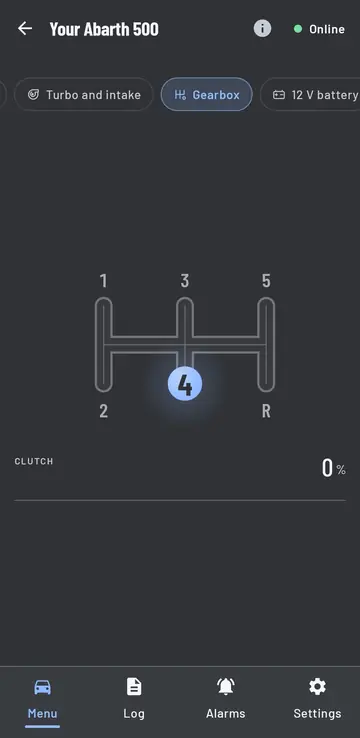
On cars that provide it, Final OBD draws the gearbox with the gear you are in and whether the clutch is pressed. And there is a very simple test to see whether it slips: on a hill, in a high gear, floor it while watching revs and speed in OBD gauges. If the revs climb and the speed does not keep up, it is slipping.
Open the bonnetthe in-depth explanation
The force that clamps the disc
What transmits the torque is the friction of the disc between the flywheel and the plate. The pressure plate spring, a dish-shaped diaphragm spring, clamps with several hundred kilos, and the more torque the engine has, the stronger the spring and the bigger the disc must be. That is why clutches on powerful engines have a heavier pedal, or use a self-adjusting plate that compensates for lining wear so the pedal feel does not change with mileage.
As the lining wears, the disc gets thinner, the spring clamps less, and there comes a point where engine torque beats the friction: it slips. A lining soaked in oil from a leaking crankshaft or gearbox seal will slip even when new.
The hydraulic circuit
On most cars the pedal pushes a small master cylinder, and the fluid, usually the same as the brakes and from the same reservoir, moves a slave cylinder that works the release bearing. As brake fluid absorbs moisture over the years, the circuit ages too: a pedal that stays down, comes back slowly or changes feel when hot needs the master and slave cylinders checked and the system bled.
Inside the dual-mass flywheel
There are two masses: the primary one, bolted to the crankshaft, and the secondary one, on which the clutch disc rubs. Between them are long arc-shaped springs packed in grease that let one turn slightly relative to the other. Each kick from a firing compresses the springs instead of reaching the gearbox in full.
Over the years the grease goes, the springs tire and play appears. A garage checks it by turning the secondary mass by hand or with a tool and measuring how far it moves and whether it springs back. What punishes it is the same as the clutch, plus one thing: lugging the engine at very low revs in high gears, which is exactly when the engine’s kicks are strongest. On diesels, sitting at 1,100 rpm in sixth to save fuel is a bad idea for the flywheel.
Solid flywheel: what you gain and what you lose
A solid flywheel kit has a one-piece flywheel and a disc with bigger springs in the centre, which absorbs some of the vibration. It is cheaper and has nothing that wears except the disc. What you lose is refinement: more vibration at idle and at low revs, more gearbox noise and, on some engines, more punishment for the synchromesh and the gearbox bearings. If your car does mostly open road, you notice it less; if it is a town diesel, you notice it quite a lot.
How to make them last
Foot off the pedal while driving. On hills, the handbrake or hill-start assist, not the clutch. Always pull away in first and without many revs. Do not leave the engine labouring in high gears. And when you replace the clutch, replace the dual-mass flywheel too if it has play: they come off together and the labour is the same, so doing it twice means paying for it twice.
All sections of the mechanics guide
See it in your own car
Almost everything in this guide can be seen with Final OBD and an adapter plugged in: faults explained, live data and the details of each system.