

Cooling: circuit, thermostat, water pump and radiator
An engine throws away through the radiator almost as much energy as it turns into motion. Here is where the coolant goes, what it cools besides the engine, what the thermostat is for and why the gauge on the dashboard does not always tell the truth.
Where the coolant goes
The water pump, driven by the belt or electric, pushes the coolant through passages that surround the cylinders and the head, the hottest parts of the engine. Illustration 1 shows it in cyan. Along the way it cools other things: the EGR cooler, the turbo, on many cars the engine oil and the automatic gearbox oil, and it also takes heat to the small heater matrix, which is where the warm air for the cabin comes from.

The thermostat
With a cold engine, the thermostat is closed and the coolant only circulates inside the engine, so it warms up as quickly as possible. At around 85 to 95 degrees it opens and lets the coolant through to the radiator at the front, the one in illustration 2, where the air cools it. When you are stationary or slow and not enough air gets through, the fan cuts in.

The circuit is pressurised, with an expansion tank and a cap that holds the pressure. That way the coolant does not boil at 100 degrees but well above that. That is why you never open that cap with a hot engine: boiling coolant shoots out.
What fails most
A thermostat stuck open makes the engine take ages to warm up: the heater does not heat, the car uses more fuel and a fault is logged. One stuck closed makes it overheat. The water pump eventually leaks at its shaft or gets noisy. A hose or the radiator can corrode through. And the most serious, the head gasket: coolant disappearing with no visible leak, white smoke, bubbles in the tank.
And air-cooled engines?
The Beetle, old Porsche 911s and many motorbikes have no coolant: the cylinders have fins and a fan blows air over them, with the oil doing part of the job. No pump, no radiator, no hoses to rot. On the other hand they are noisier and keep a stable temperature less well, which is why cars moved away from them.
The most common faults
- Thermostat stuck open
The engine does not reach its temperature, the heater is weak and consumption goes up.
Typical codes: P0128, P0125 - Coolant temperature sensor
If it reads wrong, the engine starts badly when cold, uses more fuel or the fan does not cut in when it should.
Typical codes: P0115, P0116, P0117, P0118 - Radiator fan
On the open road nothing happens, but in a traffic jam the engine overheats.
Typical codes: P0480, P0481 - Electronically controlled thermostat
Many modern engines heat it with a resistor to open it earlier. If it fails, the engine runs hotter or colder than it should.
Typical code: P0597 - Engine overheating
Low coolant, the pump, a blocked radiator, a thermostat stuck closed or the head gasket. Stop and let it cool.
Typical codes: P0217, P2181
What you can see with Final OBD
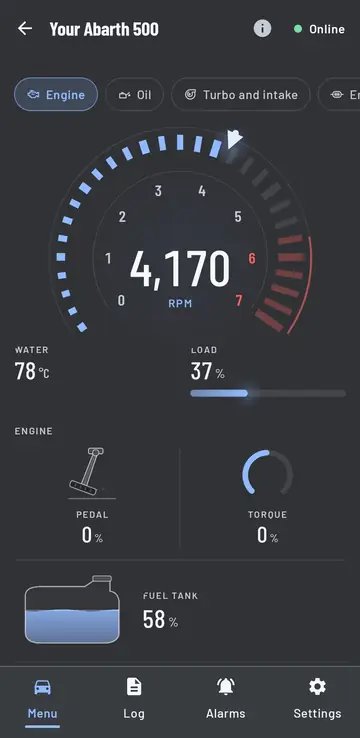
Many instrument clusters keep the temperature needle still in the middle even when the coolant is anywhere between 70 and 110 degrees, so as not to alarm anyone. Final OBD shows you the real coolant temperature live, with the engine drawing. That way you see whether the engine takes too long to warm up (thermostat) or climbs too high in traffic (fan) long before the needle moves.
Open the bonnetthe in-depth explanation
How much energy the coolant carries away
Of the energy in the fuel, roughly a third becomes motion, another third goes out of the exhaust and the coolant takes the rest. The system has to remove that heat without overdoing it: an engine that runs too cold uses more fuel, pollutes more and wears more, because the oil never reaches its proper temperature and the clearances are not the designed ones.
Pressure and boiling point
The tank cap keeps the circuit at a little over one bar above atmospheric. With that pressure and a mix of water and antifreeze, the coolant does not boil until around 120 degrees or more. When the cap stops sealing, the boiling point drops and the engine can lose coolant on a long climb in summer without any leak at all.
Coolant is not water
It is demineralised water with glycol, which lowers the freezing point (at 50 %, down to about minus 35 degrees) and raises the boiling point, plus additives that protect aluminium, iron and seals from corrosion. Those additives wear out over the years, which is why coolant is changed, usually every four or five years depending on the manufacturer. And types are not mixed at random: the colour does not tell you what it is, the standard on the bottle does.
Electric pumps and controlled thermostats
Many modern engines have an electric water pump, or a mechanical one that can be disengaged, so they do not move coolant while the engine is cold and it warms up sooner. And a thermostat with a resistor that the control unit heats to open it when it wants: hotter in gentle driving, which saves fuel, and cooler when you ask for power, which reduces knock. That is why two identical cars can show different temperatures over OBD and both be fine.
The head gasket: how to suspect it
If the engine loses coolant with no visible leak, there are bubbles in the tank with the engine running, the circuit gets hard with pressure straight away, there is sweet-smelling white smoke or a pale cream appears under the oil filler cap, think head gasket. A garage confirms it with a combustion gas test at the tank or a pressure test. Carrying on driving like that ends up warping the head.
If it overheats on the move
Turn the heater up full, which draws heat from the engine, and stop as soon as you safely can without pushing it. If the temperature keeps rising, switch the engine off. Do not open the tank until it is cold. And do not top it up with cold water while the engine is hot: the thermal shock can crack the head.
All sections of the mechanics guide
See it in your own car
Almost everything in this guide can be seen with Final OBD and an adapter plugged in: faults explained, live data and the details of each system.