

The manual gearbox: the lever and its two cables
You move the lever hundreds of times a day without thinking about what happens at the other end. Here it is: the two cables that go to the box, what each lever movement does and why a gear sometimes crunches or will not go in.
Two cables, two movements
On almost every front-engined car with a transverse engine, the lever is not attached to the gearbox: it is joined to it by two cables, the ones in illustration 1. Each takes care of one of the two movements you make with the lever.

When you move the lever sideways, the selector cable picks the plane: first and second, third and fourth, fifth and sixth or reverse. Inside the box, that turns or slides a shaft that picks up the fork for that plane.
When you push it forward or pull it back, the shift cable moves that fork, and the fork slides a sleeve that locks the chosen gear to the shaft. Forward, one gear; back, the other in the same plane. In neutral, none is locked and the gears spin freely.
The synchromesh
Before a gear is locked, its parts are turning at different speeds. Brass or fibre rings, the synchronisers, rub against the gear like a small clutch and match the speeds in an instant, so the gear goes in without crunching. When they wear, the gear crunches if you change quickly, especially second, which works hardest.
What fails
Cables stretch or break, and their plastic bushes wear: the lever wobbles, gears are hard to find or one will not go in. If every gear crunches with the clutch fully pressed, especially reverse, the problem is not the box but the clutch, which is not fully disengaging. And in the box, over the years and the miles, synchros, bearings that whine and, in bad cases, a gear that jumps out by itself.
The most common faults
- Stretched or broken cable
The lever wobbles or goes slack one way, a gear will not go in or the wrong one goes in.
- Worn cable bushes
Play in the lever and vague changes. Cheap, and you notice a big difference when they are replaced.
- Worn synchro
One particular gear crunches when you change quickly, nearly always second or third.
- Clutch not fully disengaging
Every gear crunches, especially reverse. See the Clutch and dual-mass flywheel section.
- Neutral sensor
Stop-start stops working, or the engine will not restart by itself at the lights.
Typical code: P0850
What you can see with Final OBD
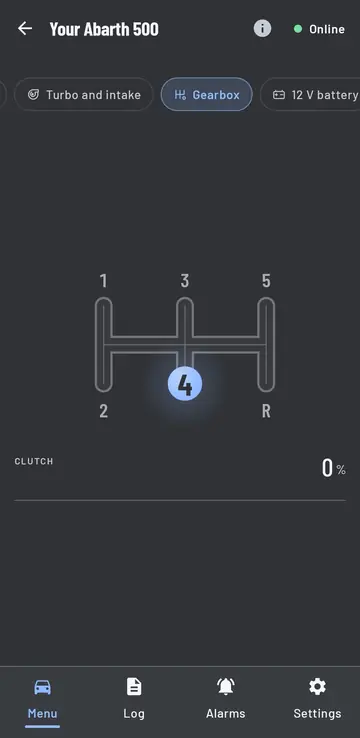
On cars that provide it, Final OBD draws the gearbox in its H with the gear you are in and the clutch. If the control unit thinks you are in a different gear from the one engaged, or does not see neutral, there is a sensor to check.
Open the bonnetthe in-depth explanation
Inside the box
A manual gearbox has an input shaft, which takes the drive from the clutch, and an output shaft, which sends it to the wheels. Each gear is a pair of gears, one on each shaft, always in mesh. One of the two is fixed to its shaft and the other spins freely on its own. Selecting a gear means locking that free gear to its shaft, and that is done by the sleeve the fork moves, with teeth that engage those on the gear.
The synchro, step by step
When you push the lever, the sleeve starts to move and presses a conical ring against a cone on the gear. The friction speeds up or slows down the gear until it turns at the same speed as the shaft. Until they match, the ring itself blocks the sleeve and will not let it through: that is why you feel a slight resistance halfway. When they match, the sleeve passes and the teeth engage. If you change faster than the synchro can match the speeds, or the ring is worn, the teeth clash: that is the crunch.
Why reverse crunches
In many boxes reverse has no synchro: it is engaged with a sliding idler gear. If the car is not completely stopped or the clutch has not fully cut, it crunches. That is why it pays to wait a second with the clutch down, or to select a forward gear for a moment first, so everything stops.
Cable or box: how to tell
With the engine off, every gear should go in smoothly. If they do not go in well with the engine off either, the problem is the cables, their adjustment or the box; if they go in with it off but crunch when running, look at the clutch. A mechanic can unhook the cables at the box and move its levers by hand: if everything goes in fine there, the problem is the cables or their adjustment, which on many cars is set at the gearbox end.
Cars without cables
On rear-wheel drive cars with a longitudinal engine, the gearbox sits right under the lever and the lever acts on it directly, without cables: that is why those gearshifts tend to be so precise. Older front-wheel drive cars used rods instead of cables.
Gearbox oil
Many manual gearboxes are sold with lifetime oil, but fresh oil helps the synchros work better and makes cold changes smoother. If your box crunches or is stiff when cold and has high mileage, changing the oil for the one the manufacturer specifies is the first and cheapest thing to try.
All sections of the mechanics guide
See it in your own car
Almost everything in this guide can be seen with Final OBD and an adapter plugged in: faults explained, live data and the details of each system.