


Air conditioning: compressor, gas and circuit
Air conditioning does not make cold: it takes the heat out of the cabin and dumps it outside. Here is how it does it, why one day it stops cooling and why it is worth switching it on in winter too.
How it removes the heat
A refrigerant gas runs round the circuit. The compressor, on the engine, squeezes it: it comes out very hot and under high pressure. In the condenser, the thin radiator in front of the engine radiator, the air cools it and it turns liquid. Then it goes through a valve that lets it expand suddenly, and as it expands it gets very cold. That is how it reaches the evaporator, hidden behind the dashboard: cabin air passes through it, gives up its heat and comes out cold. The gas goes back to the compressor and round again. Illustration 1 shows the whole circuit in light blue.

Along the way, the cold evaporator condenses the moisture in the air: that is why the air conditioning demists the windows far better than the heater alone, in winter too.
Why it stops cooling
The most common reason is that it is low on gas: circuits lose a little every year through seals and joints, and when it gets too low the compressor will not engage or cools poorly. Other times it is the compressor (its clutch, its bearing), a condenser holed by a stone, the fan not cutting in in traffic, or a pressure sensor stopping the compressor from working to protect it.
And one that is not a fault but looks like one: a clogged cabin filter. Little air comes out, it smells and the windows mist up. It is changed once a year and costs little.
The gas
Older cars use R134a; new ones, for a few years now, R1234yf, less polluting and considerably dearer. They are not mixed, and recharging is done by weight, with a machine that first pulls a vacuum and checks the circuit does not leak. Topping up by eye with a can only puts off the problem: if it leaks, it will leak again.
The most common faults
- Low on gas
It cools a little or not at all, and the compressor cycles on and off often or will not engage. There is a leak to find.
Typical code: P0534 - Refrigerant pressure sensor
The control unit will not let the compressor start because it thinks the pressure is wrong.
Typical codes: P0530, P0532, P0533 - Compressor relay or clutch
The compressor does not engage: no cold and no click when it starts.
Typical code: P0645 - Condenser or fan
It cools on the open road and stops cooling in traffic.
Typical codes: P0480, P0481 - Bad smell
Moisture and bacteria in the evaporator and an old cabin filter.
What you can see with Final OBD
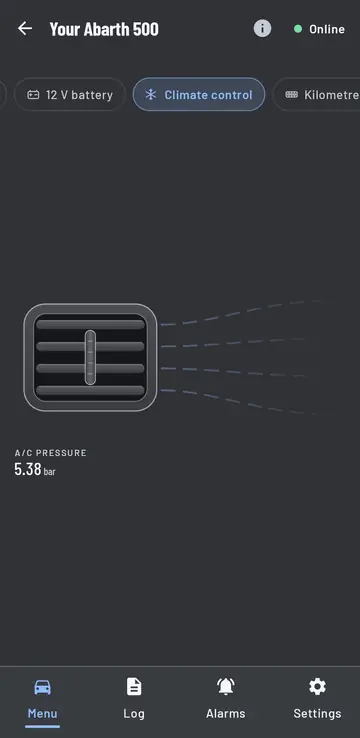
On cars that provide it, Final OBD shows the air conditioning as it looks on the dashboard, with the gas pressure live: if the pressure is low with the compressor running, it is short of gas. And you read the faults from the climate control unit, not just the engine.
Open the bonnetthe in-depth explanation
The cycle, with numbers
It is a heat pump, like a fridge. On the low side, between the expansion valve and the compressor, the gas is at around 2 or 3 bar and very cold; on the high side, between the compressor and the valve, at 10 to 20 bar or more depending on how hot it is, and very hot. The compressor uses energy to move that heat from inside to outside: that is why the car uses a little more fuel with the air on, especially in town.
Fixed, variable and electric compressors
Older ones have an electromagnetic clutch that engages and disengages the compressor: you hear the click and feel a small tug at idle. Many modern ones are variable displacement: they always turn with the belt and regulate internally how hard they work. And hybrids and electric cars have electric, high voltage compressors that can cool with the engine off. On electric cars, the same circuit often runs in reverse as a heat pump to warm the cabin using far less battery than a heating element.
The oil in the circuit
The gas carries a special oil that lubricates the compressor. That is why the compressor suffers when the circuit empties through a leak, and why it is worth running the air conditioning now and then in winter too: a few minutes every couple of weeks keep the seals lubricated and stop them drying out and leaking. It also demists faster in winter.
The gas and the environment
R134a is a very potent greenhouse gas, which is why for a few years new cars have used R1234yf, which breaks down in the atmosphere much sooner. Some German manufacturers also use CO2, which works at much higher pressures. Each needs its own recharging machine, and the charge is done by exact weight, as shown on the label in the engine bay.
When to suspect what
Cools poorly from the start and worse in heat: low gas or a dirty condenser. Cools on the open road but not in traffic: the fan. Suddenly blows warm air and then cools again: the compressor is cutting out on pressure, often for lack of gas. Makes a noise when switched on: the compressor or its clutch. Water dripping under the car with the air on: that is normal, it is the moisture condensed by the evaporator; dripping inside would be the odd thing.
All sections of the mechanics guide
See it in your own car
Almost everything in this guide can be seen with Final OBD and an adapter plugged in: faults explained, live data and the details of each system.