


AdBlue: how it works and why it fails
Almost every diesel from recent years has a second filler cap, usually blue, next to the diesel one. That is where the AdBlue goes, and if it runs out or the system fails, the car warns you well in advance and in the end will not start. Here is what it does and what tends to go wrong.
What AdBlue is
It is demineralised water with 32.5 % urea, the same substance used as fertiliser but extremely pure. It is not a diesel additive and it never mixes with the fuel: it has its own tank, its own pump and its own injector, all separate. Illustration 1 shows it in blue.

Its job is to clean up the nitrogen oxides (NOx) coming out of the engine. The system sprays it into the exhaust pipe, the heat turns it into ammonia, and in a special catalyst, the SCR, that ammonia reacts with the NOx and leaves nitrogen and water, which is what comes out of the tailpipe. It does the same job as the EGR, but after the engine and much better. That is why diesels with AdBlue can use less EGR and get less dirty.
How much it uses and what happens if it runs out
It depends a lot on the car and how it is driven, but as a rough idea, a car uses between one and two litres every thousand kilometres (roughly every 600 miles). The tank lasts many thousands of miles; in vans, and driving loaded, less.
When it gets low, the car warns you with a message and a countdown of miles. Take notice: if it reaches zero, the regulations require the car not to start again until you refill it. The same happens if the system has a fault that is not fixed within the time it gives you: first it warns, then it counts down and in the end it will not start.
Three things that avoid almost every problem
Use proper AdBlue, the kind whose label says it meets ISO 22241, and never water, whatever anyone tells you. Do not put it in the diesel tank (if it happens, do not start the car and call a recovery truck: it is far cheaper than starting it). And keep the cap and the filler neck clean: dried AdBlue leaves white crystals, and any dirt that gets in can end up in the injector.
The most common faults
- Crystallised AdBlue
White crusts on the injector, in the lines or in the exhaust mixer. More common with short trips, a cold exhaust or a dripping injector. The car reports a system fault or high NOx.
Typical codes: P20EE, P2BAD - Blocked or sticking AdBlue injector
If it does not spray properly, the SCR catalyst does not get what it needs and cleaning drops. Sometimes cleaning it is enough; sometimes it has to be replaced.
Typical codes: P2047, P20EE - Pump not building pressure
It usually sits inside the tank itself. If there is no pressure, the system cannot inject.
Typical code: P20E8 - Heater
AdBlue freezes at minus eleven degrees, so the tank and the lines are heated. If the heater fails, you find out in winter.
Typical code: P20B9 - NOx sensors
One before and one after the SCR catalyst. They are expensive and suffer with heat and age; if one reads wrong, the engine control unit thinks the system is not cleaning.
Typical codes: P2200, P2201, P229F - Level or quality
The tank sensor measures how much is left and, on many cars, whether what is in there is real AdBlue. If someone filled it with water, it trips.
Typical code: P203F
What you can see with Final OBD
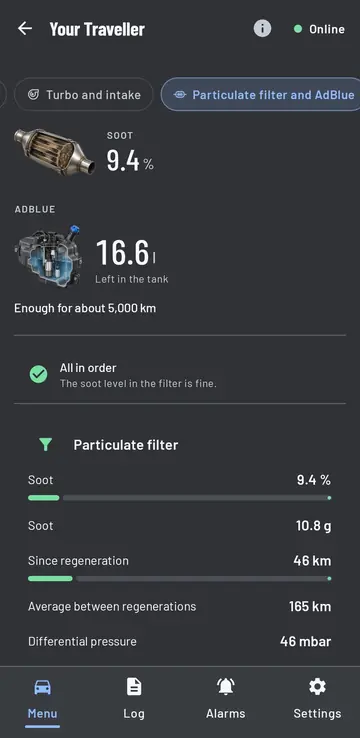
On cars that provide it, Final OBD shows the AdBlue next to the particulate filter, starting with how much is left in the tank. The screen alongside is from a Peugeot Traveller connected in one of our test sessions: the soot in the filter and the litres of AdBlue left.
And if a warning comes on, you see the faults from the engine control unit and from the AdBlue one, when it is separate, with their code and explained.
Open the bonnetthe in-depth explanation
The chemistry, in short
When it hits the hot exhaust, the water in the AdBlue evaporates and the urea breaks down into ammonia and carbon dioxide. The ammonia does the work: in the SCR catalyst (selective catalytic reduction) it reacts with nitrogen monoxide and nitrogen dioxide and leaves nitrogen and water vapour. Selective, because the ammonia goes after the NOx and not after the oxygen, of which a diesel exhaust has plenty.
It needs heat to work. Below about 200 degrees in the exhaust there is no injection, because the urea would not break down and would leave deposits. That is why the system does less in town, with a cold exhaust, and why short trips do not suit AdBlue either.
All the parts, in order
First, the tank: ten to twenty litres in a car, more in vans, with its level sensor, its temperature sensor and, on many cars, a quality sensor that checks the urea concentration. Inside the tank or bolted to it are the pump, which gives a few bar, and the heater.
Then the line, also heated, which runs along the underside of the car to the injector, screwed into the exhaust pipe before the SCR. There is almost always a mixer that spreads the AdBlue mist evenly through the gas. Then the SCR catalyst and, after it, a small catalyst that eats any leftover ammonia so it does not come out of the tailpipe. And the two NOx sensors, the one before and the one after.
On many diesels the SCR is built into the particulate filter itself, a filter with a coating that does both jobs at once.
How it decides how much to inject
The engine control unit calculates the NOx leaving the engine, or measures it with the first sensor, looks at exhaust temperature and gas flow, and doses accordingly. The second sensor, after the SCR, checks the result. If NOx stays high for a while, it logs the efficiency fault, P20EE. That code does not say which part has failed: it says the system as a whole is not cleaning what it should. It could be the injector, the AdBlue itself, a NOx sensor that reads wrong or the catalyst.
The SCR also stores some ammonia on its surface, like a small reserve. Managing that reserve is the finest part of the system: too little and it does not clean; too much and ammonia slips out of the tailpipe.
Why it crystallises
When AdBlue dries, it leaves solid urea, white crystals that look like salt. It happens in three places. At the filler neck and cap, if it spills while filling. On the injector and the mixer, if the exhaust is not hot enough or the injector drips. And in the lines, if they stay full. That is why, after switching off, you often hear the pump for a little while: it is sending the AdBlue in the lines back to the tank so it does not sit there, freeze or crystallise.
Crystals at the filler come off with warm water. Those on the injector and mixer are a garage job: strip, clean and sometimes replace the injector.
Winter
AdBlue freezes at minus eleven degrees, and that is fine: the system is designed for it and, once the engine starts, the heater thaws it in a few minutes. In the meantime the car runs normally and the SCR waits. What you should not do is add anything to stop it freezing: anything mixed into AdBlue ruins it.
The countdown and the no start
European regulations require that you cannot keep driving indefinitely without AdBlue or with the system faulty. That is why the car warns you with a countdown and, when it reaches zero, it will not start again once switched off. If the tank was empty, refilling is enough; on some cars you have to add a minimum amount and leave the ignition on for a while so it recognises it. If it is a fault, it has to be fixed and cleared; while it is still there, the countdown keeps running.
What you should never do
No water, no AdBlue of doubtful origin, and no reusing cans that have held something else. The system is very sensitive to concentration and to any impurity (metals, salts, traces of oil). Bad AdBlue can poison the SCR catalyst and damage the pump and the injector, and that is a serious bill. A large can with the standard on the label costs little and lasts for months.
All sections of the mechanics guide
See it in your own car
Almost everything in this guide can be seen with Final OBD and an adapter plugged in: faults explained, live data and the details of each system.