


Turbo, intercooler, blow-off valve and oil cooler
Almost every car today has a turbo, diesel or petrol. Here is how it works, what each part around it does, what you really gain by changing the intercooler or adding an oil cooler, and why turbos break.
How a turbo works
A turbo is two bladed wheels joined by a shaft. One, the turbine, sits in the exhaust: the gases leaving the engine spin it. The other, the compressor, sits in the intake: as it spins, it forces air into the engine under pressure. More air means more fuel can be burnt, which means more power from a smaller engine. That shaft spins at more than 100,000 rpm, and it is lubricated by the engine oil.

Illustration 1 shows the path of the air in blue: into the turbo’s compressor, through a pipe to the intercooler, where it cools, and back to the intake manifold.
The intercooler
Compressing the air heats it, and hot air takes up more room and carries less oxygen. The intercooler is a radiator that cools it before it enters the engine. Colder air is denser (every ten degrees cooler is roughly 3 % more air in the same space), and on top of that the engine knocks less and the exhaust runs cooler.
Does a bigger one give more power? On a standard car driven normally, very little: the original already cools quite well. The real gain is when the standard one gets heat-soaked, in summer, after several hard pulls in a row, on a track or on an engine whose boost has been raised. And a badly designed or oversized one can make the turbo lazier to respond and lose pressure along the way.
Blow-off valve and oil cooler
When you lift off suddenly, the throttle closes and the air the turbo was still pushing has nowhere to go. The blow-off valve lets it out so it does not hammer the compressor. Some are better than others: standard ones with a rubber diaphragm eventually split and leak boost, and those that vent to the atmosphere, on cars with a mass airflow sensor, dump air the engine control unit has already counted, so the engine can run rich or stall.
An external oil cooler lowers the oil temperature when the engine is worked hard for a long time: track days, towing, long climbs in summer. In normal use you gain nothing, and without a thermostat the oil takes longer to warm up in winter, which is worse. It is only worth it if the oil temperature really climbs, and always with a thermostat.
The most common faults
- Not enough boost
The car will not pull. Most often it is not the turbo but a leak: a loose or split hose, a holed intercooler or the blow-off valve. On diesels, variable geometry vanes stuck with carbon.
Typical codes: P0299, P2263 - Too much boost
Turbo control cannot rein it in and the engine control unit cuts power to protect it. Usually the actuator, its solenoid or variable geometry that will not move.
Typical codes: P0234, P0045, P0046 - Boost pressure sensor
If the sensor reads wrong, the engine control unit regulates wrong: limp mode even with a healthy turbo.
Typical codes: P0236, P0237, P0238, P2563 - Turbo passing oil or with play
Blue smoke, oil in the intercooler hoses, a siren-like whistle. The shaft has play.
What you can see with Final OBD
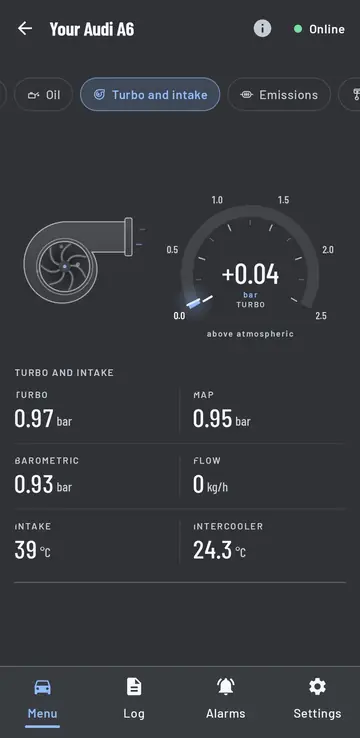
On cars that provide it, Final OBD shows the turbo on its own gauge: the boost it makes, the intake manifold pressure, the atmospheric pressure at that moment and the temperature after the intercooler. On the screen, an Audi A6 3.0 TDI connected in one of our test sessions. Tap the pressure and the app explains what it is and what values are normal.
It is the quickest way to find out whether a car that will not pull has low boost or something else.
Open the bonnetthe in-depth explanation
How boost is controlled
An uncontrolled turbo would keep making more pressure until it broke itself or the engine. On petrol engines it is controlled with a valve, the wastegate, which lets part of the exhaust bypass the turbine. On diesels it is almost always variable geometry: movable vanes around the turbine that close at low revs, so the gas enters fast and the turbo spools early, and open at high revs so it does not overboost.
Both are moved by an actuator, pneumatic with a solenoid or electric, and the engine control unit keeps correcting it by comparing the pressure it asks for with what the manifold sensor measures. When the difference stays large for a while, it logs under or overboost.
Absolute pressure and boost
The manifold sensor measures absolute pressure: at idle, on a turbo engine, it reads roughly the same as the atmosphere, about 1 bar at sea level. What the turbo blows is the difference between that pressure and the atmospheric one. That is why Final OBD shows you both. On a modern diesel at full load, 2 to 2.6 bar absolute is normal; on a small petrol engine, somewhat less. What matters is not a single figure but that actual pressure follows the requested one.
Mind the altitude: on a mountain pass atmospheric pressure drops and the turbo has to work harder to give the same absolute pressure. That is why many cars limit power a little at high altitude.
Why turbos break
The shaft spins on a film of oil. Almost every turbo death has to do with that: old or low oil, a blocked oil feed pipe, switching off right after working the engine hard, with the turbo glowing and the oil sitting still and cooking. Modern ones are also water-cooled and some have a pump that keeps running after switch-off, but a minute at idle after a hard climb is still a good habit. And no full throttle with a cold engine.
The other enemy is debris: something that gets into the intake and hits the compressor, or bits from the engine reaching the turbine. That is why, when a turbo is replaced, the oil and filter are changed and the intercooler is cleaned too: if the old turbo shed pieces, they are still in there.
Variable geometry and carbon
On diesels that do a lot of town driving, the variable geometry vanes slowly gum up with carbon, because they never fully open or get hot enough. One day they stick and the turbo gives too little or too much boost. Same as for the EGR and the particulate filter: a good run with the engine working now and then keeps them clean.
The intercooler, in depth
An intercooler is judged by two things: how much it cools and how much pressure it costs. If the air at the outlet is only a few degrees above ambient, it is doing its job; if it comes out hot after several pulls, it is heat-soaked. And every metre of pipe and every core add pressure drop and volume the turbo has to fill before you feel the shove.
That is why big intercoolers make sense on engines worked hard for long periods or with raised boost. And before changing anything, check whether that part needs approval to pass the MOT and to keep your insurance happy: any change that is visible or that affects the car’s performance may count as a modification.
All sections of the mechanics guide
See it in your own car
Almost everything in this guide can be seen with Final OBD and an adapter plugged in: faults explained, live data and the details of each system.