

EGR and diesel particulate filter: how they work and why they clog
They are the two parts that cause the most headaches on modern diesels, and almost always for the same reason: the way we use the car. Here is what each one does, why they clog and what you can do to stop it happening to you.
The EGR: sending some of the exhaust back into the engine
The EGR (exhaust gas recirculation) is a valve that takes part of the gas coming out of the exhaust and feeds it back into the intake. Putting exhaust fumes back into an engine sounds daft, but there is a reason for it: that gas has already burnt, it will not burn again, and when it mixes with the fresh air it lowers the combustion temperature. With less heat, far fewer nitrogen oxides are formed, the NOx, which are among the worst things that come out of an exhaust pipe.

Illustration 1 shows the path in orange: the gas leaves the exhaust manifold, goes through a cooler, passes the valve and goes back into the engine through the intake.
The trouble is that diesel exhaust gas carries soot, and oil vapour from the crankcase also reaches the intake. Together they make a black paste, carbon, which builds up on the valve, the manifold and the cooler. When the valve sticks, open or closed, the car loses power, smokes black, puts the engine light on and sometimes goes into limp mode.
The particulate filter: a trap for soot

The diesel particulate filter (DPF, or FAP on some French cars) sits in the exhaust, under the car and after the catalytic converter: it is the orange part in illustration 2. Inside it is a ceramic honeycomb with every other channel blocked, so the gas has to go through the walls, which are porous, and the soot stays behind. It catches almost all of it, more than 95 %.
A filter that only ever fills up would end up blocked, so every so often it has to be emptied, and that is the regeneration: burning the soot at around 600 degrees so it leaves as gas. On a good motorway run part of it burns off by itself. If not, the engine control unit forces it: it injects a little extra diesel to heat the exhaust and keeps it hot for ten to twenty minutes. Switch the engine off during that time and the regeneration is left half done.
And that is where most of the problems come from: diesels that only ever do short trips around town. The filter keeps filling, the regenerations never finish, and one day the filter warning light comes on or the car will not rev past 3,000.
Why your car needs a good run now and then
It is not a garage myth. A spell on the open road with the engine working a bit, not screaming but not in sixth at 1,500 rpm either, does everything good: the exhaust gets hot, the filter cleans itself, regenerations finish and the EGR gets hotter, cleaner gas that leaves less carbon behind. For diesels that do a lot of town driving I recommend half an hour on the motorway every week or two, in a gear that keeps the engine at 2,500 to 3,000 rpm.
And keep the injectors healthy. An injector that drips or sprays badly makes more soot, and the filter fills up sooner. The filter problem is often somewhere else.
Removing the EGR or the filter: what it is and why not
Removing means taking the part out, or disabling it, and reprogramming the engine control unit so it does not notice. People do it to avoid a repair bill or because someone sold them the idea that the car runs better. I will be straight with you: driving like that is illegal, it is heavily enforced and I advise against it completely. The car will fail its MOT, you risk a fine, your insurer may cause trouble after an accident and, on top of that, you blow into the air everything those parts were there to stop. You will not find how to do it here. You will find how to keep them healthy, which is almost always cheaper.
The most common faults
- EGR stuck or full of carbon
Loses power at low revs, judders, smokes black and sometimes goes into limp mode. A proper clean often fixes it without replacing the valve.
Typical codes: P0401, P0400, P0402, P0404 - Electrical fault in the valve
The small motor or its position sensor: the engine control unit asks for an opening and the valve does not get there or does not report where it is.
Typical codes: P0403, P0405 - Particulate filter loaded with soot
Filter warning light, regenerations that never finish, the fan still running after you switch off. Almost always caused by short trips.
Typical codes: P2463, P244B, P2002 - Differential pressure sensor
The one that measures how hard it is for the gas to get through the filter. If it fails, or one of its little pipes splits or comes off, the engine control unit thinks the filter is full or empty when it is not.
Typical codes: P2452, P2453, P2454, P2455 - Filter full of ash
Ash does not burn. With high mileage the filter slowly fills with it and no regeneration will help: it needs a professional clean or replacing.
Typical code: P242F - Leaking EGR cooler
On some engines it cracks inside and coolant ends up in the intake: the coolant level drops with no leak in sight and the car smokes white.
What you can see with Final OBD
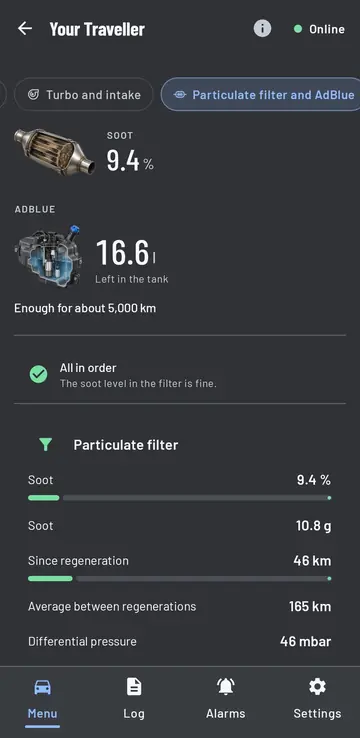
On diesels that provide it, Final OBD shows the particulate filter on its own page, with whatever each car gives: the soot the engine control unit calculates, the state of the filter and, on many cars, the distance since the last regeneration. It is the best way to find out whether your journeys let it finish. I check that figure on my Traveller now and then, and if I see it climbing and never dropping, I know it is due a motorway run.
For the EGR, if your car gives it over standard OBD, you see the opening the engine control unit asks for and how far the real one is off. And the faults from every control unit, with their code, explained.
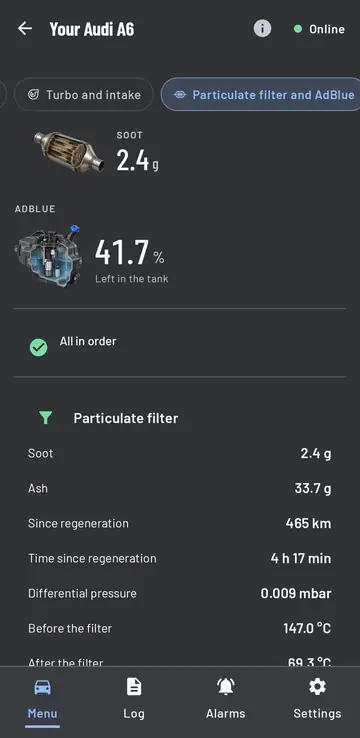
On other cars, like this Audi A6 3.0 TDI, the filter page also shows the accumulated ash, which regenerations do not remove, and the differential pressure.
Open the bonnetthe in-depth explanation
Why NOx forms and how the EGR holds it back
Air is almost all nitrogen and oxygen. At normal temperatures they leave each other alone, but inside a cylinder, at the peak of combustion, the temperature goes well past 1,800 degrees, and then they do react and form nitrogen oxides. Diesels have it worse than petrol engines because they always run with air to spare: more free oxygen and more heat.
The EGR takes away part of the fresh air from the cylinder and replaces it with gas that has already burnt, mostly CO2 and water vapour. That gas does not burn, but it takes up room and soaks up heat, so combustion is slower and its peak temperature lower. On a diesel at light load up to a third of what goes in can be exhaust gas. At full load the EGR closes, because that is when you need oxygen to burn the fuel.
Everything has a price: with less oxygen, more soot forms. It is the eternal diesel tug of war, NOx against particles, and that is why the EGR and the particulate filter almost always go together.
High pressure, low pressure and the cooler
The classic EGR, the one in illustration 1, is the high pressure type: it takes the gas from the exhaust manifold, before the turbo, and puts it into the intake manifold. It is the one that gets dirtiest, because the gas arrives just as it leaves the engine, soot and all.
Many modern engines also have a low pressure EGR, which takes the gas after the particulate filter, already clean, and puts it in before the turbo. It gets far less dirty and lets the high pressure one work only when needed.
Almost all of them pass the gas through a cooler, a small radiator with engine coolant running through it. Cooler gas is denser and better at bringing the temperature down. The cooler is also what gives you the coolant loss scare when it cracks.
How the engine control unit knows the EGR is working
Modern valves are electric and have a sensor that reports how far open they are. The engine control unit compares what it asks for with what it measures, and if they do not match for a while, it logs a fault. It also watches the air coming in: when the EGR opens, the mass airflow sensor should see less fresh air going in, because part of the room is taken by exhaust gas. If it does not see that, no gas is getting through the EGR; if it sees too much, too much is getting through.
That is why a dirty EGR usually gives P0401 even when the valve moves fine: the sensor says it is open, but the passage is so full of carbon that the gas cannot get through.
The filter inside: soot and ash
The filter is a block of ceramic, silicon carbide or cordierite, with thousands of very fine channels. One channel is open at the front and closed at the back; the next one, the other way round. The gas goes in through one, crosses the porous wall and leaves through its neighbour, and the particles stay stuck to the wall.
What stays inside comes in two kinds, and it pays not to mix them up. Soot is carbon, it comes from badly burnt diesel and it burns off in regenerations. Ash comes mainly from the additives in the oil that the engine burns little by little (calcium, zinc, phosphorus) and it never burns: it piles up at the back of the channels over the whole life of the filter. With high mileage it takes up so much room that the filter is full even straight after a regeneration. That is why it matters so much to use the oil the manufacturer specifies, a low ash one, and to have an engine that does not burn oil.
Passive, active and additive regeneration
Passive regeneration happens on its own. With the exhaust between 250 and 450 degrees, the nitrogen dioxide made by the oxidation catalyst, which sits in front of the filter, burns the soot off bit by bit. It happens on the motorway, with the engine under load.
Active regeneration is triggered by the engine control unit when it calculates that the filter is loaded. It adds small injections of diesel after combustion; that diesel reaches the oxidation catalyst unburnt, burns there and takes the exhaust up to around 600 degrees. You can tell if you pay attention: slightly higher idle, the fan running on after you switch off, a bit more fuel used, a hot smell. Switch off halfway through and it is left half done; it will try again later.
Some manufacturers use an additive, in a separate tank, that is mixed into the diesel in tiny amounts and makes the soot burn at a lower temperature. That tank needs topping up every many thousands of miles, and if it runs dry the filter ends up blocked.
A garage can force a regeneration with the car standing still and a diagnostic tool. It is a good fix when the filter is loaded but healthy; if the problem is ash or an injector, it comes back.
Differential pressure and the soot calculation
The engine control unit knows how much is in the filter in two ways. On one side it calculates it with a model: fuel burnt, miles covered, how the car has been driven. On the other it measures the pressure difference between the inlet and the outlet of the filter with a sensor and two small pipes. With a clean filter and the engine idling the difference is just a few millibar; as the filter fills it rises, and you see it most with the engine revving and lots of gas flowing.
If the calculation and the measurement do not agree, something is up: a split or loose pipe, a sensor that no longer reads properly or a filter that has cracked inside and lets gas through unfiltered, which is the efficiency below threshold fault, P2002.
Oil that rises on the dipstick
There is a side effect of regenerations that few people know about: some of the diesel from those late injections wets the cylinder walls and runs down into the sump. If regenerations keep getting cut short, the oil gets diluted with diesel and its level rises. Watery oil lubricates worse. If you see the oil level going up instead of down, that is not good news: change it and find out why the regenerations are not finishing.
Petrol engines too
For a few years now many direct injection petrol engines have had their own particulate filter. It fills up far more slowly and almost always regenerates by itself, because a petrol engine runs a hotter exhaust, but the principle is the same. Carbon build-up in the intake also hits direct injection petrol engines: the fuel no longer goes past the intake valves, so it no longer washes them.
What really works
If the EGR is dirty, a thorough clean is usually enough. If the filter is loaded with soot, a good regeneration, on the road or forced at the garage. If it is full of ash, a professional filter clean or a new one. And in every case, find the reason: journeys that are too short, a dripping injector, a turbo passing oil, the wrong oil. Fixing the symptom without the cause means paying twice.
All sections of the mechanics guide
See it in your own car
Almost everything in this guide can be seen with Final OBD and an adapter plugged in: faults explained, live data and the details of each system.