

Misfires, catalytic converter and lambda sensors
They share a chapter because they are linked: a misfiring cylinder sends unburnt fuel to the catalytic converter, the converter overheats, and the lambda sensors are the ones that report that something is wrong. If your engine light is flashing, start here.
What a misfire is
A four-cylinder engine runs because in each cylinder, in turn, the air and fuel mixture burns and pushes the piston down. When it does not burn in one of them, or burns badly, that is a misfire. You can feel it: the engine shakes at idle, judders when you accelerate and loses power. The engine control unit logs it with the cylinder number: P0301 is cylinder one, P0302 cylinder two, and P0300 when it is several or it moves from one to another.

On a petrol engine the usual suspects are that cylinder’s spark plug and coil, the yellow parts in illustration 1. After that come the injector, an air leak and, the most serious, poor compression in that cylinder. A diesel has no spark plugs: it is almost always the injector and, from cold, the glow plugs.
If the light flashes, ease off
A steady engine light tells you there is a fault. A flashing one tells you the misfires are so frequent they can wreck the catalytic converter. Fuel that does not burn in the cylinder goes into the exhaust, burns inside the converter and heats it so much it can melt inside. So if it flashes: no hard acceleration, take it gently and get it to a garage as soon as you can.
The catalytic converter

It is the part of the exhaust close to the engine (in orange, in illustration 2) that turns the most toxic gases, carbon monoxide, unburnt hydrocarbons and nitrogen oxides, into carbon dioxide, water and nitrogen. Inside it is a honeycomb coated with precious metals, and it has to be hot to work.
A healthy converter lasts a very long time. They die from misfires nobody fixed in time, from an engine burning oil or from a knock. The classic code is P0420: catalyst efficiency below threshold.
The lambda sensors
They are two sensors screwed into the exhaust, one before the converter and one after it; in illustration 2 they are orange too. The one before measures the oxygen left over in the exhaust, and with that the engine control unit adjusts the mixture on the fly so it is just right. The one after keeps an eye on the converter: if the oxygen at the outlet rises and falls just like at the inlet, the converter is no longer doing its job, and that is when P0420 appears.
Their most common fault is not the sensor itself but its heater, a resistor that warms it up so it starts measuring as soon as the engine starts. It fails with age and gives codes like P0030 or P0135.
The most common faults
- Spark plug or coil
The most common cause on petrol engines. An old garage trick: swap the coil to another cylinder and see whether the misfire follows it.
Typical codes: P0301, P0302, P0303, P0304, P0351 - Injector
On diesels, cause number one: it drips, it sticks or it does not deliver what it should.
Typical codes: P0300, P0201 - Worn-out catalytic converter
Often the result of something else: misfires, burnt oil or a mixture that has been wrong for months.
Typical codes: P0420, P0430 - Lambda sensor heater
The most common lambda sensor fault. The sensor still measures, but it takes longer to start.
Typical codes: P0030, P0135, P0036, P0141 - Slow or out of range sensor
With age and dirt they get lazy: they react slowly and the mixture is no longer spot on.
Typical codes: P0133, P0130, P0137, P0138 - Lean or rich mixture
The engine control unit has reached the limit of what it can correct. An air leak, a dirty mass airflow sensor, fuel pressure or an injector.
Typical codes: P0171, P0172
What you can see with Final OBD
With Final OBD you see the misfires the engine control unit has counted in each cylinder, on cars that report them over OBD. It is the best way to catch a cylinder that is starting to misfire before the light comes on.
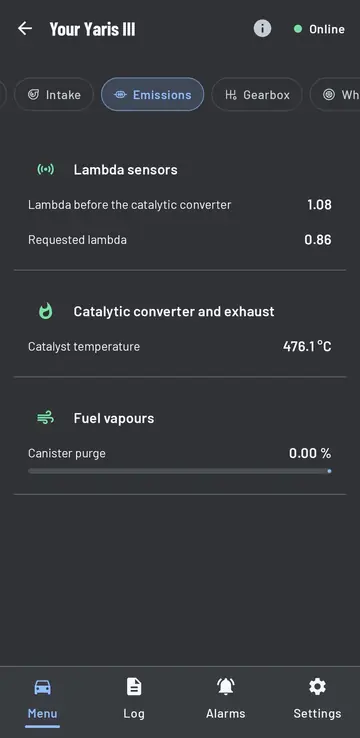
You see both lambda sensors live, the one before and the one after the catalyst, and the fuel trim the engine control unit is applying. On the screen, the sensors of a Toyota Yaris hybrid.
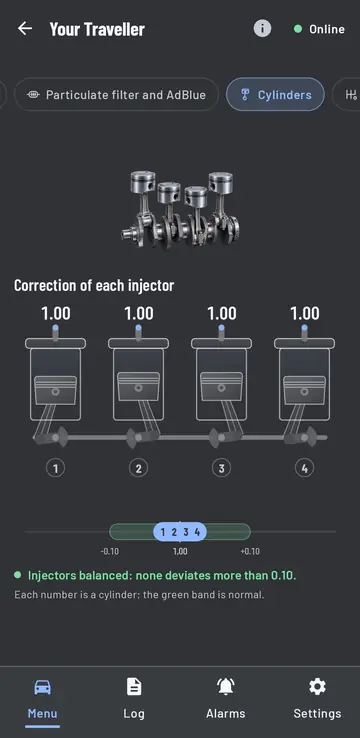
On diesels, many cars also show the correction of each injector, cylinder by cylinder, with its normal band. If one goes outside it, you know where to start looking.
Open the bonnetthe in-depth explanation
How the engine control unit detects a misfire
There is no sensor inside the cylinder that sees the flame. The engine control unit works it out from the crankshaft. Each combustion gives it a push (the mixture burning above each piston, in illustration 3), so the crankshaft turns in tiny surges: it speeds up very slightly with every firing. The crankshaft sensor measures the time between the teeth on its wheel with huge precision, and when it is a cylinder’s turn to push and the crankshaft does not speed up as it should, the engine control unit logs a misfire for that cylinder.

It counts them in batches of revolutions and compares them with two limits. The emissions limit, checked every thousand revolutions: if it is exceeded, the fault is logged and the light comes on steady. And the limit that can damage the catalyst, checked every two hundred revolutions, which is the one that makes the light flash. On a very bumpy road the crankshaft also turns in surges, which is why many cars stop watching for misfires when they detect a rough surface.
That count per cylinder is what Final OBD shows from the test results the engine control unit stores (what OBD calls mode 06). Not every car provides it.
Where to look, in order
On a petrol engine: the spark plug (check its colour and wear; if it is due by mileage, do not think twice), the coil (try it on another cylinder), the connector and wiring, the injector, an air leak in that cylinder’s intake and, last of all, compression. If all the cylinders misfire at once, think of something they share: fuel, the mass airflow sensor, a big air leak or the timing.
On a diesel: injectors first (their correction per cylinder tells you a lot), glow plugs if it happens from cold, and compression. A diesel that shakes when cold and settles once warm almost always has a tired glow plug.
The catalytic converter inside
It is a ceramic or metal block with thousands of channels, covered with a porous layer containing platinum, palladium and rhodium. On a petrol engine it is a three-way catalyst: it oxidises carbon monoxide and hydrocarbons (adds oxygen to them) and reduces nitrogen oxides (takes it away) at the same time. Both at once only work with an exact mixture, the stoichiometric one: 14.7 parts of air to one of petrol, what is called lambda 1. That is why the sensors matter so much.
It starts working at around 250 to 300 degrees. The first minutes after a cold start are the dirtiest, which is why modern cars do everything they can to heat it quickly: they retard the ignition and raise the idle.
And it has one key property: it stores oxygen. When the mixture is a touch lean, it soaks it up; when it is a touch rich, it releases it. That smooths out the swings in the mixture. An old converter loses that ability, and that is exactly what the engine control unit measures.
How the engine control unit decides the converter is bad
It compares the two sensors. Using the front one, the engine control unit runs the mixture a touch rich and then a touch lean, over and over, all the time. If the converter stores oxygen well, the rear sensor does not notice that swing and gives an almost flat signal. If it is worn, the swing gets through and the rear sensor starts copying the front one. When they look too alike during the test, P0420 appears.
So a P0420 is not always the converter. An exhaust leak between the converter and the second sensor (air gets in and skews the reading), a rear sensor that no longer reads properly or an engine whose mixture is out of control can all give the same code. Before replacing a converter, which is not cheap, it is worth ruling out those three things.
Narrowband and wideband sensors
Traditional sensors, the narrowband type, can only say rich or lean: they give around 0.9 volts with a rich mixture and around 0.1 with a lean one, and jump from one to the other as they cross lambda 1. Most of those after the converter are still like that.
Wideband sensors, almost always the front ones these days, tell you how rich or lean the mixture is, with a number: lambda 0.95, lambda 1.02. They are more complex, have a cell that pumps oxygen, and the engine control unit reads them as a current. Diesels, which always run with air to spare, use these: at lambda 1.5 or more, a narrowband sensor would be useless.
Fuel trims
Using the front sensor, the engine control unit corrects the fuel on the fly (short term fuel trim) and, if a correction keeps repeating, it learns it (long term fuel trim). Both show up in OBD as a percentage: positive means it is adding fuel because the mixture was lean; negative, that it is taking fuel away because it was rich.
A few points either way is normal. If the long term trim goes beyond plus or minus 10 %, there is something to watch, and at around 25 % the engine control unit runs out of room and logs a lean or rich mixture. A clue that works: if the trim is very positive at idle and comes right when you rev the engine, it is usually an air leak; if it is similar across the whole range, look at fuel delivery or the mass airflow sensor.
How to drive with an unfixed misfire
If you have a misfire that has not been fixed, do not load the engine: climbing hills in a high gear or flooring it is when it misfires most and the converter suffers most. And do not leave it. A coil costs far less than a catalytic converter.
All sections of the mechanics guide
See it in your own car
Almost everything in this guide can be seen with Final OBD and an adapter plugged in: faults explained, live data and the details of each system.