


How an engine works: petrol, diesel, hybrid and electric
Before you can understand why something fails, it helps to know how it works. Here are the basics of every engine you will find on the road today, from the good old petrol engine to the electric car, by way of hybrids, which are the ones that raise the most questions.
The four strokes
A petrol or diesel engine does four things in each cylinder, over and over: the piston goes down and air comes in (intake), goes up and squeezes it (compression), the fuel burns and pushes it down hard (power) and it goes up again pushing the gases out (exhaust). The crankshaft turns that up and down into rotation. Illustration 1 shows the key moment in orange: the mixture burning above each piston.

Petrol and diesel: the real difference
In a petrol engine, the air and fuel mixture is lit by a spark from the spark plug, and the amount of air is controlled by a throttle: the more you press, the more it opens. A diesel has no spark and, almost never, a throttle: it compresses only air, so much that it heats to more than 500 degrees, and the diesel injected into that red-hot air ignites by itself. That is why a diesel compresses much more, has more pulling power at low revs and uses less fuel, and why it needs a particulate filter and, almost always, AdBlue.
Hybrids

Besides the petrol engine, a hybrid has one or two electric motors and a small battery (in green, in illustration 2). When pulling away and at low speed, with a light foot, it can run on electricity alone. When you ask for power, above a certain speed, when the battery drops below its margin or when it is cold and the heater needs heat, the petrol engine starts. And when you brake or lift off, the electric motor works in reverse and recharges the battery: that is the energy a normal car throws away as heat through its brakes.
Mild hybrids, the 48 volt ones, are something else: a small electric motor that helps the combustion engine and lets it switch off more often, but they almost never move the car on their own.
Plug-ins and electric cars

A plug-in hybrid is a hybrid with a much bigger battery, charged from the wall, good for 40 to 100 kilometres (25 to 60 miles) on electricity. When it runs out, it behaves like a normal hybrid. An electric car has no combustion engine at all: the battery fills the floor and one or two motors drive the wheels, as in illustration 3. No gearbox, no clutch, no engine oil, no exhaust. In exchange, the battery is everything, and its health matters most when buying one used.
The most common faults
- Misfires
A cylinder that is not burning properly: the engine shakes and loses power. All of it in Misfires, catalyst and lambda sensors.
- Carbon and the particulate filter
The nightmare of town diesels. Explained in EGR and particulate filter.
- Turbo short of boost
Almost every engine today has a turbo. See Turbo and intercooler.
- Tired hybrid battery
The petrol engine starts more often and the car uses more fuel. See Batteries.
- Timing
The fault that scares people most on a used car. See Timing belt and chain.
What you can see with Final OBD
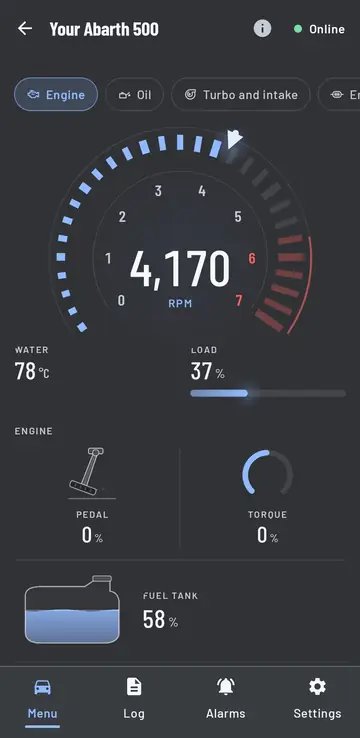
On a petrol or diesel car, Final OBD draws the engine with what is happening inside, live: revs, coolant temperature, load and pedal. On the screen, an Abarth 500’s.
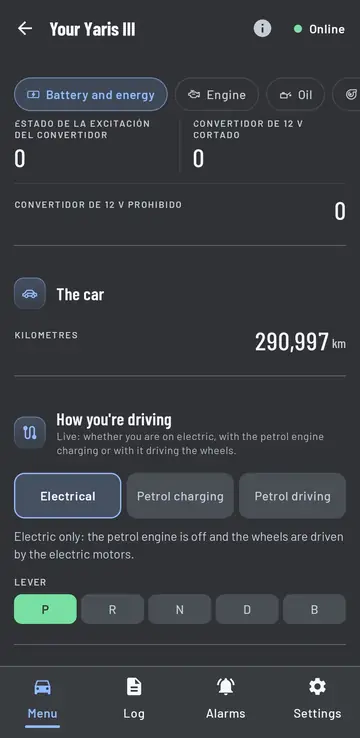
On a hybrid it tells you at every moment how you are driving: electric only, with the petrol engine charging the battery, or with both pushing. It is the best way to understand when and why the combustion engine kicks in. On the screen, a Toyota Yaris hybrid.
Open the bonnetthe in-depth explanation
Why a combustion engine wastes so much
Of all the energy in the fuel, a petrol engine turns into motion, at best, between 30 and 38 %, and a diesel a little more, up to 40 or 45 %. The rest goes as heat: through the exhaust and through the radiator. That is physics: a heat engine can only use part of the heat, and the more it compresses and the hotter it burns, the more efficient it gets. That is why a diesel, compressing 15 to 18 times against 10 to 14 for a petrol engine, uses less fuel.
An electric motor, on the other hand, turns more than 90 % of the energy it receives into motion. That is the big advantage of electric cars, and what hybrids exploit in town.
Direct injection, turbos and fewer cylinders
Today’s engines inject fuel directly into the cylinder at very high pressure (on a common rail diesel, more than 2,000 bar) to meter it precisely. And they have a turbo to get the pulling power of a big engine from a small one: that is downsizing, the three-cylinder 1.0 that performs like an old 1.6. It works in the official test cycle and in gentle driving; when you push it hard, it uses as much as what it delivers.
How a hybrid shares out the energy
There are three ways to combine a petrol engine and an electric motor. In parallel, both drive the wheels, each in its own way, through the gearbox. In series, the petrol engine does not drive the wheels: it only drives a generator that feeds the electric motor, which does the pushing. And the most common one in Toyota and Lexus hybrids, the combined type: a planetary gear splits the petrol engine’s power between the wheels and a generator, and two electric motors adjust everything, without a stepped gearbox. That is why such a hybrid sounds as if the clutch were slipping when you accelerate: the petrol engine goes to the revs where it is most efficient and stays there.
Those petrol engines usually run on the Atkinson cycle, which closes the intake later: less pulling power but lower consumption, and the electric motor makes up what is missing.
When the petrol engine kicks in, in depth
The hybrid system’s control unit decides moment by moment based on how much power you ask for, speed, battery charge and temperature. With the battery in its good zone and a light foot, it runs on electricity. If you ask for power, the petrol engine starts and both push. If the battery runs low, the petrol engine recharges it while driving the car. And when cold it starts to heat the catalytic converter, which has to be hot to clean the exhaust, and to give heat to the heater. That is why a hybrid uses a little more in winter.
Inside an electric car
The battery supplies direct current at 300 to 800 volts. An inverter turns it into alternating current, at the frequency each moment needs, to drive the motor, which is almost always a permanent magnet one. A single-speed reduction gear brings the revs down to the wheels. When braking, the inverter does the opposite: the motor generates and the current goes back to the battery. A small converter charges the 12 volt battery, which is still needed to wake everything else up.
That is why an electric car needs so little maintenance: almost everything that wears out in a combustion car does not exist. What does age is the battery, which is why its health is the first question when buying one used.
All sections of the mechanics guide
See it in your own car
Almost everything in this guide can be seen with Final OBD and an adapter plugged in: faults explained, live data and the details of each system.